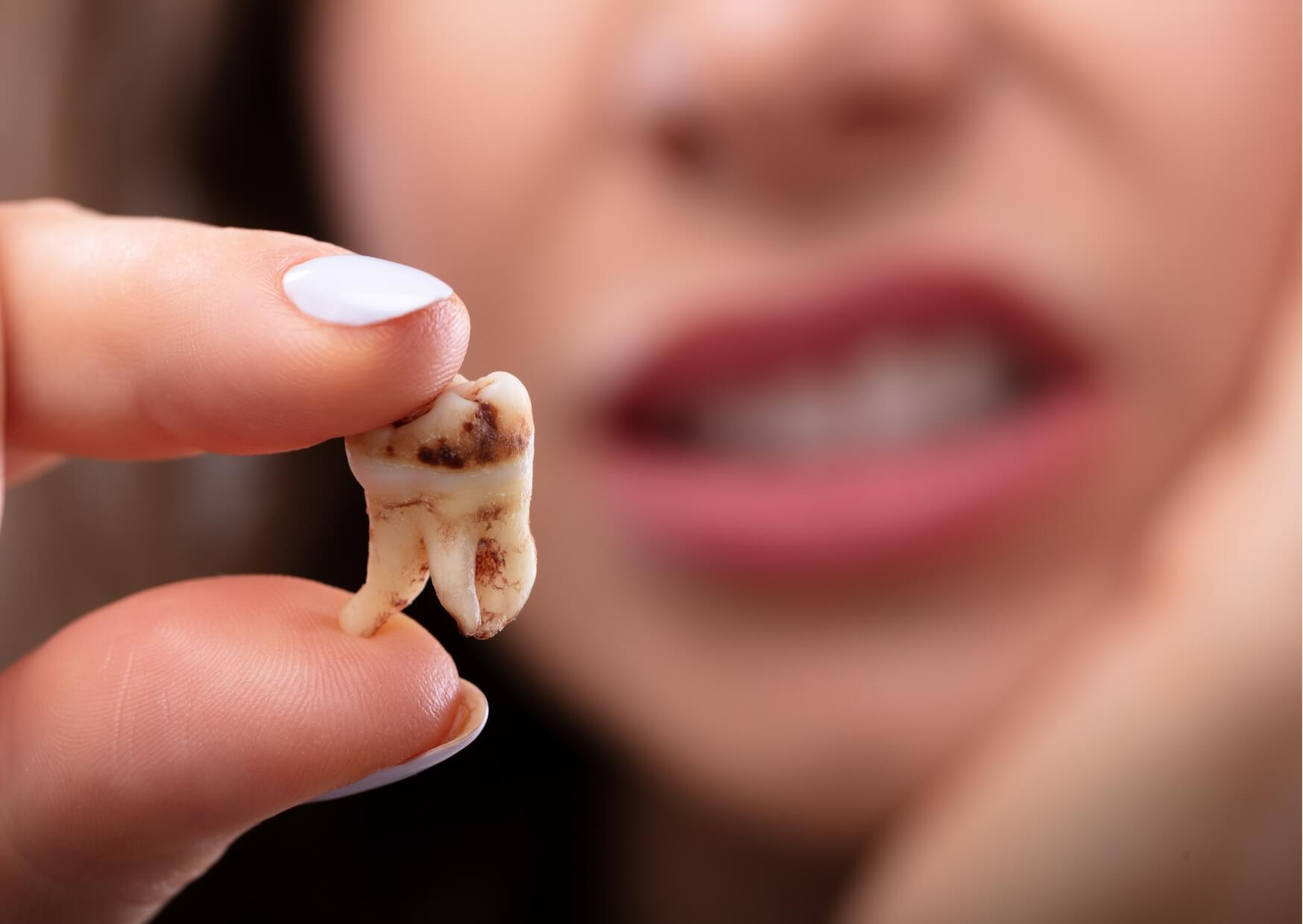
Tooth decay does not always start as an obvious hole. It often begins as a subtle change in the enamel, the hard outer layer of the tooth, and may first look like a chalky white spot, a dull patch, or a small area of discoloration.
As decay progresses, the tooth may turn yellow, brown, or black. Some areas look rough or shadowed, while others develop a small visible hole or pit.
The way decay looks depends on its stage and location. A back molar may show dark staining in the chewing grooves, while decay near the gumline may look like a soft, discolored notch.
Pain is not always present early on. That is one reason many patients miss the first signs until a dental exam or X-ray shows more than they can see in the mirror.
At Downtown Dental Nashville in Nashville, TN, we provide dental fillings to restore teeth with visible cavities and discoloration.
Tooth decay begins with mineral loss. Bacteria in plaque, a sticky film on the teeth, feed on carbohydrates from food and drinks and produce acid.
That acid lowers the pH around the tooth and gradually pulls minerals from the enamel. Early damage may still improve through remineralization, but once the surface breaks down, the tooth cannot fully repair itself without treatment.
Saliva, fluoride, dry mouth, diet, and oral hygiene all affect how fast this happens. Acidic drinks like energy drinks can speed enamel loss. Read more about energy drinks and decay.
In daily life, decay often forms where plaque sits undisturbed, especially in deep molar grooves, between teeth, and along the gumline. To help prevent decay between teeth, see our tips on effective flossing.
A regular dental cleaning and screening can remove buildup and catch early changes before they become a true cavity.
The earliest visible sign is often a chalky white spot on the tooth. This happens when enamel loses minerals and becomes more porous, which changes how it reflects light.
Some early areas look matte instead of glossy. Others appear slightly yellow or light brown, especially if weakened enamel starts to pick up stains.
At this stage, the tooth may still feel smooth, and there may be no pain at all. Decay between teeth is even harder to see and may only show up on dental X-rays.
Not every white or dark spot is decayed. Some marks come from staining, enamel defects, or older dental materials, which is why a clinical exam matters.
When decay breaks through enamel and reaches dentin, the softer layer under it, the damage often becomes easier to see. The tooth may show brown or black spots with a visible pit or a rough, broken surface.
Some cavities look like a small crater. Others appear as a dark line in a groove or a shadow under the enamel, especially when the top layer is still partly intact.
As the tooth weakens, the edge may chip. In some cases, a patient notices a hole with trapped food, a bad taste, or a new area that feels sharp against the tongue.
| Location | What It May Look Like |
| Chewing surface of molars | Dark groove, pit, or small hole |
| Between teeth | Often not visible directly; may show as a shadow or food trap |
| Near the gumline | Brown, yellow, or soft-looking notch close to the gum |
| Around an old filling or crown | Dark margin, rough edge, or breakdown near the restoration |
Once decay gets close to the pulp, the inner tissue with nerves and blood supply, pain may become stronger or linger after hot, cold, or sweet foods.
There is no single appearance that confirms decay in every case. Some cavities are pale and soft, while others are dark and hard, especially if the area has picked up stains over time.
Front teeth may show a white spot or edge discoloration first. Back teeth more often hide decay in grooves or between contact points where brushing cannot reach well.
Dry mouth can also change the pattern. Patients with reduced saliva from medications, mouth breathing, or medical conditions may develop decay on surfaces that are usually lower risk.
That is one reason home checks are limited. A tooth can look mostly normal on the outside while decay is spreading underneath or between teeth.
Tooth decay may cause no symptoms early on, but common changes often appear as it gets deeper. Patients frequently notice new cold sensitivity or discomfort when eating sweets.
Food may start getting stuck in one spot. A rough edge, bad taste, or persistent bad breath can also happen if bacteria collect in a broken-down area.
Pain with biting may mean the cavity has weakened the tooth or that a crack is also present. More severe throbbing, swelling, or pain that wakes someone from sleep needs prompt dental attention because it may point to deeper infection or pulp inflammation.
For more detail on warning signs, see our article on cavity symptoms.
These signs need urgent evaluation. They do not always mean the same diagnosis, but they can point to a problem that should not wait.
A dental exam focuses on whether the tooth is intact, weakened, or actively breaking down. The dentist looks at the color, texture, shape, and location of the area and checks whether it fits a typical decay pattern.
Softness, surface breakdown, plaque buildup, and food retention all matter. Bite forces matter too, because a stressed tooth can chip around a cavity or an older filling.
X-rays are often needed, especially for decay between teeth or under existing restorations. In some offices, photos, transillumination, or cavity-detection tools may also be used, and more detailed scans like advanced imaging can help clarify hidden problems, but the diagnosis still depends on the full clinical picture.
Learn why 3D dentistry matters for finding hidden cavities.
This distinction matters because not every spot needs drilling, and not every normal-looking tooth is healthy underneath.

If enamel is demineralized but not yet cavitated, meaning no true hole has formed, treatment may focus on remineralization and risk reduction. That can include fluoride, diet changes, better plaque control, and closer monitoring.
Once there is a cavity, the damaged tooth structure usually needs to be removed and restored. Dental fillings are common for smaller areas, while a larger defect may need an inlay, onlay, or crown to rebuild strength.
If decay reaches the pulp and causes irreversible inflammation or infection, root canal treatment may be needed to save the tooth. You can also read more about root canal treatment.
If the tooth cannot be restored predictably, extraction is sometimes the safer option. The right treatment depends on depth, symptoms, fracture risk, and whether the area will be cleanable long term.
A small visible spot can sometimes hide deeper damage, while a dark area may turn out to be shallow and stable.
When decay is caught early, treatment is often simpler and less invasive. Small lesions may be monitored or treated before they cause pain, while established cavities are usually scheduled for restoration to stop progression.
After a filling, mild sensitivity can happen for a short time. Deeper cavities, especially those close to the pulp, may take longer to settle and sometimes need additional treatment if symptoms continue.
Long-term success depends on controlling the cause, not just repairing the tooth. If dry mouth, frequent snacking, high sugar intake, or difficult-to-clean areas are still present, new decay can form around the same tooth or nearby teeth.
A dental visit is a good idea if a tooth has a new white spot, dark area, rough patch, or visible hole. The same is true if there is sensitivity, food trapping, or a change in how the tooth feels when chewing.
Do not wait for severe pain before getting evaluated. Decay often progresses quietly, and earlier treatment is usually more conservative, less costly, and more predictable.
If the area is changing quickly, causing significant pain, or linked with swelling, seek prompt care. A dentist can determine whether the problem is active decay, staining, wear, a crack, or another issue that needs a different approach.
If you are unsure whether a spot is harmless or the start of a cavity, a focused dental exam is the safest next step and often the fastest way to get a clear answer.
Downtown Dental Nashville provides dental fillings in Nashville, TN and serves patients from nearby areas such as East Nashville and Germantown. Call (615) 254-1393 to schedule an exam.
Yes. Early decay often appears as a chalky white spot because the enamel has lost minerals. Brown or black color is more common after the area has picked up stains or broken down further.
No. Some dark spots are only stains, especially in deep grooves of molars. A dentist may need to examine the texture and take X-rays to tell the difference.
Yes. Decay can develop between teeth or under the enamel before a visible hole forms. That is why pain, sensitivity, or food trapping can matter even when the tooth looks mostly normal.
It often does not look like much from the outside. Patients may notice floss shredding, food catching, or a dark shadow near the contact point, but many cases are first found on X-rays.
Decay becomes more urgent when there is severe pain, swelling, fever, drainage, or trouble swallowing or breathing. Those symptoms need prompt professional evaluation.
| Monday | 7:00 AM – 5:00 PM |
| Tuesday | 7:00 AM – 5:00 PM |
| Wednesday | 7:00 AM – 5:00 PM |
| Thursday | 7:00 AM – 5:00 PM |
| Friday | 7:00 AM – 3:00 PM |
| Saturday | Closed |
| Sunday | Closed |