Most people don’t realize that mouth breathing is a complex health concern that can lead to sleep apnea, speech impediments, and improper facial growth.
If your child is mouth breathing, s/he can learn to change the habit. That’s where we come in. It’s our job to help patients learn how to change the habit and breathe properly. Learning how to breathe through the nose instead of the mouth prevents pediatric patients from a slew of serious health issues in adulthood, including sleep apnea, speech impediments, improper facial growth, and restricted oxygen flow to the brain and other tissues.
For some people, breathing through the mouth is due to nasal airway restriction, but for others an open mouth is simply a habit — their mouth rests in an open position when they’re not focused on keeping it closed. We call this either “open mouth resting posture” or "mouth breathing”
The natural position for healthy breathing is always with a closed mouth, inhaling and exhaling through the nose.
Some adults are very aware of their open mouth habit, while others have never noticed it until they meet me. Most of the time, adult patients are self-conscious about their open mouth habit, and can’t understand why it’s so challenging for them to keep their lips together when they aren’t speaking or eating.
Does Mouth Breathing Actually Matter That Much?
While having an open mouth may seem like a silly thing to be concerned about, and even a simple problem to fix, it’s actually neither.
The Serious Health Effects of Mouth Breathing
Teeth and braces: If your mouth is open, it is impossible for you to have healthy tongue posture and swallowing habits. This will limit the growth potential of your palate which will create teeth problems, such as crooked or crowded teeth, overbite, overjet, a narrow arch, and a gummy smile. Due to these complications your braces will take longer and your treatment will be much more challenging for your orthodontist. Additionally, the stability of the alignment of your teeth will be compromised once your braces are removed. This means you are likely to experience orthodontic relapse and you may need braces again in the future.
Speech: When children have an open mouth, they are more likely to struggle with certain speech sounds. The most commonly associated speech problem is a lisp, or the inability to say “S” sounds correctly. Speech is affected because when you have an open mouth, you also have what we refer to as a “tongue thrust swallowing pattern.” This type of swallowing pattern causes the tongue to protrude, or push forward during speaking and swallowing.
Facial growth and development: It’s important to realize that growth is a very powerful force. A child with an open mouth will very likely grow into an adult with flatter facial features, less prominent cheekbones, a longer face, droopier eyes and lower facial muscle tone, a narrower palate, a smaller retruded jawline, and poor chin and neck definition. By closing the mouth and breathing through the nose, these negative growth patterns can be avoided and your child will grow to their ideal beauty and health potential.
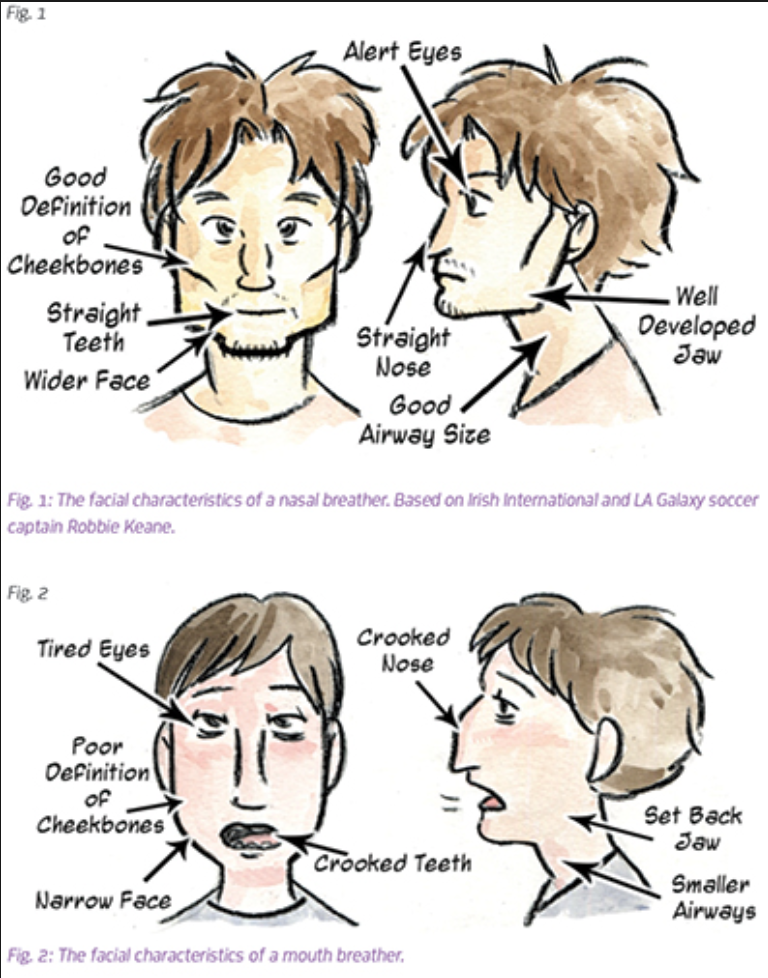
Sleep and oxygen:When adults and children breathe through their mouths during the day, chances are very high that they also breathe through their mouths all night long as well. Mouth breathing at night, combined with an retruded jaw and smaller airway, are two symptoms directly connected to sleep apnea and altered levels of carbon dioxide and oxygen in the bloodstream. When less oxygen is able to reach the brain, learning and the ability to focus at school becomes a problem for many children. In adults, chronic fatigue, tiredness, and brain fog are common symptoms related to these issues. During the day, mouth breathing results in poor origination of brain and other body tissues, higher CO2 levels in the body, and reduced oxygen intake in the lungs. Your nasal cavity is also not able to filter your air, removing viruses, bacteria, and other particles from the air you breath.
What Causes an Open Mouth or Mouth Breathing Habit?
It can be difficult to determine the root cause of an open mouth or mouth breathing habit. However, most people tend to have one or more of these three contributing factors:
They have (or had) a breathing or airway problem. Many open mouth habits can be traced back to breathing issues such as allergies, chronic colds/stuffy noses, enlarged tonsils and adenoids, asthma, a deviated nasal septum, and much more. The interesting thing to note is that once the airway problem is resolved, the habit remains. We see many children who have had their adenoids removed, but still breathe through their mouth. This is where myofunctional therapy comes in – muscle, swallowing, and breathing patterns often need to be relearned after the airway obstruction is eliminated.
They have (or had) a thumb or finger sucking habit. When the thumb is in the mouth, especially for an extended period of time, the oral and facial muscles will develop around this habit. If the thumb is in the mouth, the lips are not able to form a seal, and a tongue thrust swallowing pattern develops as well. Just because a child stops sucking his or her thumb does not mean the mouth breathing symptoms will go away. The same thing that occurs with airway issues often occurs with sucking habits – the habit is stopped, but the mouth breathing remains. Myofunctional therapy, along with orthodontic treatment, is often needed after a thumb/finger sucking habit has been eliminated.
They have (or had) a tongue-tie. A tongue-tie is serious medical condition—not just a common expression for when someone can’t get their words out. This condition may also be referred to as a restricted lingual frenum, or a tethered tongue. If a patient has this condition, they often need their tongue released through a simple surgical procedure in order to maintain a closed mouth posture. The position of the tongue plays a very important role in nasal breathing and growth and development, so if the tongue is limited by a physical restraint, it may be very difficult to stop mouth breathing. For patients who have a tongue-tie, they can be taught helpful exercises before and after their surgery, and eventually, they are able to close their mouth and breathe through their nose naturally and easily.
What Parents Can Do to Prevent Mouth Breathing
Now that you are aware of these symptoms, you can look for them in yourself or your child. You can get started by doing the following:
Monitor yourself or your child for mouth breathing and/or an open mouth resting posture. How often does it occur during the day?
Determine if you have any of the airway or breathing issues mentioned above, or if you’ve had them in the past.
Consider talking to a doctor who specializes in breathing and sleep. It may be time to have a sleep study done for you or your child. There are two types—at home, and in-clinic. Your doctor can help you determine the best option for you, and how to get started.
Have an evaluation with a myofunctional therapist/dentist. We screen our patients for all of these symptoms, as well as many others.
Bottom line: breathing through the mouth all the time, including when you are sleeping, can lead to problems. In children, mouth breathing can permanently change the child's growth trajectory causing crooked teeth, facial deformities, and limiting the child's health and lifespan. In adults, chronic mouth breathing can complicate and contribute to gum disease, bad breath, and many serious health conditions.
| Monday | 7:00 AM – 5:00 PM |
| Tuesday | 7:00 AM – 5:00 PM |
| Wednesday | 7:00 AM – 5:00 PM |
| Thursday | 7:00 AM – 5:00 PM |
| Friday | 7:00 AM – 3:00 PM |
| Saturday | Closed |
| Sunday | Closed |